Cornerstone Guide
Window replacement in Deltona: the complete guide
Everything a Deltona homeowner needs before spending money on windows, in the order the decisions arrive.
Deltona is a good place to write a window guide about, because the housing is unusually consistent. The city was platted in 1962, when the Mackle Brothers bought 17,203 acres and laid out 35,143 lots, and it filled in steadily from there. Census figures put the median house at around 1990, with close to thirty percent of the stock built in the 1980s and another thirteen percent in the 1970s. That means most Deltona houses share a construction era, a wall type and, very often, the original windows.
What is probably in your openings
If the house dates from the 1970s or 1980s, the odds are strong that the windows are the ones it was built with: thin-frame aluminum single-hungs and horizontal rollers holding a single pane of glass. That was the universal Florida specification of the era. They are recognizable without measuring anything. The frames are silver or bronze anodized and narrow. The lower sash rattles when a truck goes past. The lock does not quite meet. And on a humid morning the frame itself runs with water, which is the giveaway that matters most.
That condensation is not a leak and it is not a glass problem. Bare aluminum is an excellent conductor, and an unbroken aluminum frame runs straight through the wall from outside to inside. The indoor face of the frame therefore sits close to outdoor temperature, and in a climate this humid that is cold enough for room air to give up its moisture onto the metal. Nothing you do to the glass changes it, because the frame is the bridge.
If the house dates from the 1990s or later, and roughly forty percent of Deltona does, the original windows are already insulated units in vinyl or aluminum frames. Those fail differently. Instead of rattling, they fog: the perimeter seal on the sealed unit gives up, moist air gets into the cavity, and a permanent haze appears between the panes. Seal failures cluster, because every unit in the house was manufactured in the same batch, so what starts as one window is usually several.
The wall is the other half of the job
Almost every exterior wall in Deltona is concrete block with a stucco skin. This is the single biggest difference between window work here and window work in a wood-frame state, and it changes the installation in three specific ways.
First, the window anchors into masonry rather than nailing to a stud. Second, the weather line is the sealant joint between the frame and the stucco, not a lapped flashing behind a nailing flange. Third, the stucco is carried into the opening and there is an interior return of plaster or drywall over block, both of which get disturbed when the old frame comes out and both of which have to be made good afterward.
None of this is difficult for a crew that works block every day. It is, however, the part of the job where corners get cut, because a poorly tooled sealant joint looks fine on handover day and shows up as a stain on the interior return two rainy seasons later. When you read a quote, look for the perimeter work to be described rather than assumed.
The two ratings on a Florida window
Every quote you get will carry both, and they get confused with each other constantly.
Design pressure is the wind load the assembly holds, positive pressure pushing in and negative pressure pulling out, expressed in pounds per square foot. It is a property of the frame, the anchors, the glass and the hardware working as one, not of the glass on its own, which is why a well-rated window fixed with the wrong fasteners stops performing like the number on its label. The block wall guide goes into how anchoring into masonry interacts with it.
Impact rating is a different test and a different question. An impact-rated assembly has had a timber missile fired at it and then been pressure cycled thousands of times on the already-broken glass, and it passes by keeping the opening sealed rather than by keeping the glass intact. That matters because what damages a house in a storm is the sudden pressurization when an opening fails, not the broken pane itself.
Deltona sits more than fifteen miles inland, well outside the coastal strip, and for most houses here impact glazing is a choice rather than a foregone conclusion. Whether anything different applies at a specific address is a question for the city Building Division and the wind speed mapping Volusia County publishes, and it is worth asking them directly rather than accepting a salesperson's answer on it. The impact and shutter comparison works through how to make the call.
The glass carries a third set of numbers that has nothing to do with wind: solar heat gain, conduction and how much daylight gets through. In a climate that spends most of the year cooling, those decide what the windows do to a power bill, and the glass guide works through how to read them.
What it costs
National cost tracking for 2026 puts a standard replacement window near $800 installed, with most work between $450 and $1,200 per opening, and a whole house of ten to fifteen windows in the $8,000 to $12,000 range. Impact-rated units run closer to $1,250 apiece, which roughly doubles a whole-house figure. Those are estimates rather than quotes, and Florida sits inside those bands rather than outside them.
The per-window number falls as the count rises, because the measure visit, the delivery and the crew mobilization are fixed costs spread across the order. That is the honest argument for doing the whole house at once, and it is the only one. The cost guide breaks the numbers down further, and the calculator turns a window count into a bracket.
How the install runs
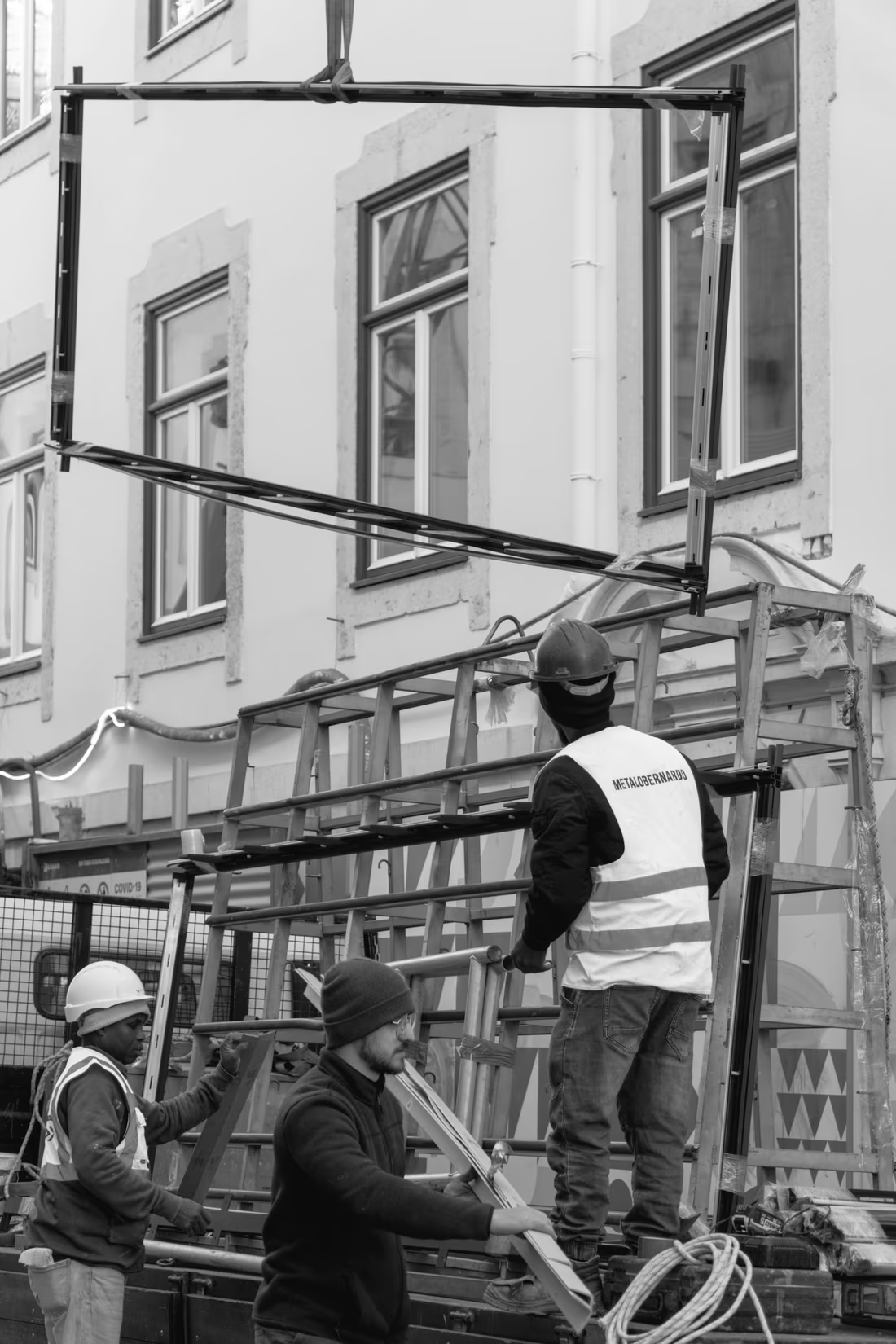
The part homeowners brace for is usually the shortest part of the project. A single-story Deltona block house of ten to eighteen openings is commonly one to two days for a full crew. Two-story work and shaped or arched units add time, and so does anything that needs the masonry altered, but a straightforward like-for-like swap moves quickly because the units arrive built to the measured sizes and go into the hole whole.
Rooms are worked one at a time rather than the whole house being opened up at once. Furniture within a few feet of an opening gets moved back, window coverings come down, and the house is closed up each evening rather than left open overnight. Expect noise, and expect dust around the perimeters, because cutting an old frame out of stucco and block is not a tidy operation.
What separates a good crew from a cheap one is what happens at the end of each opening rather than at the start. The exterior sealant joint gets tooled properly, the interior return is patched back to a paintable finish, and the old frame, sash and glass leave the site. Painting to match is usually not included, which is worth settling before the crew arrives rather than after.
The order to do things in
- Work out what you have. Aluminum single-pane, or insulated units that have started fogging. The answer changes what replacement buys you.
- Decide on impact rating before you get quotes. It is the largest single variable in the price, and comparing an impact quote against a standard quote tells you nothing.
- Get the openings measured. Nobody can price this from a photo or a plan set, because the product is built to the measurement.
- Read the glass package off the label, not off the brochure adjectives.
- Check the scope covers the perimeter and the disposal, and ask what the lead time is.
Where to go next
If the decision is impact glass or shutters, start with that comparison. If the driver is an insurance renewal, the wind mitigation guide explains how protection turns into a credit. If you already know what you want, the whole-house page covers how a full order runs, and a free measured quote starts with a form or a phone call.